What a personal link is
A personal link is one recipient's own address for a form, such as tinyforms.tools/i/k7m2qpza. It is not a copy of the form: it is your form, opened with that person's answers already filled in, their choices narrowed to what applies to them, and a reference of yours travelling along without ever being shown.
The address carries no question mark and no parameters, and the code avoids characters that are easily misread, so it fits on a printed invitation and survives being typed back in capitals.
Part of the Business plan
Generating and managing personal links needs Business. Links that already exist keep working even if the workspace moves to a smaller plan, so an invitation already in the post is never invalidated.
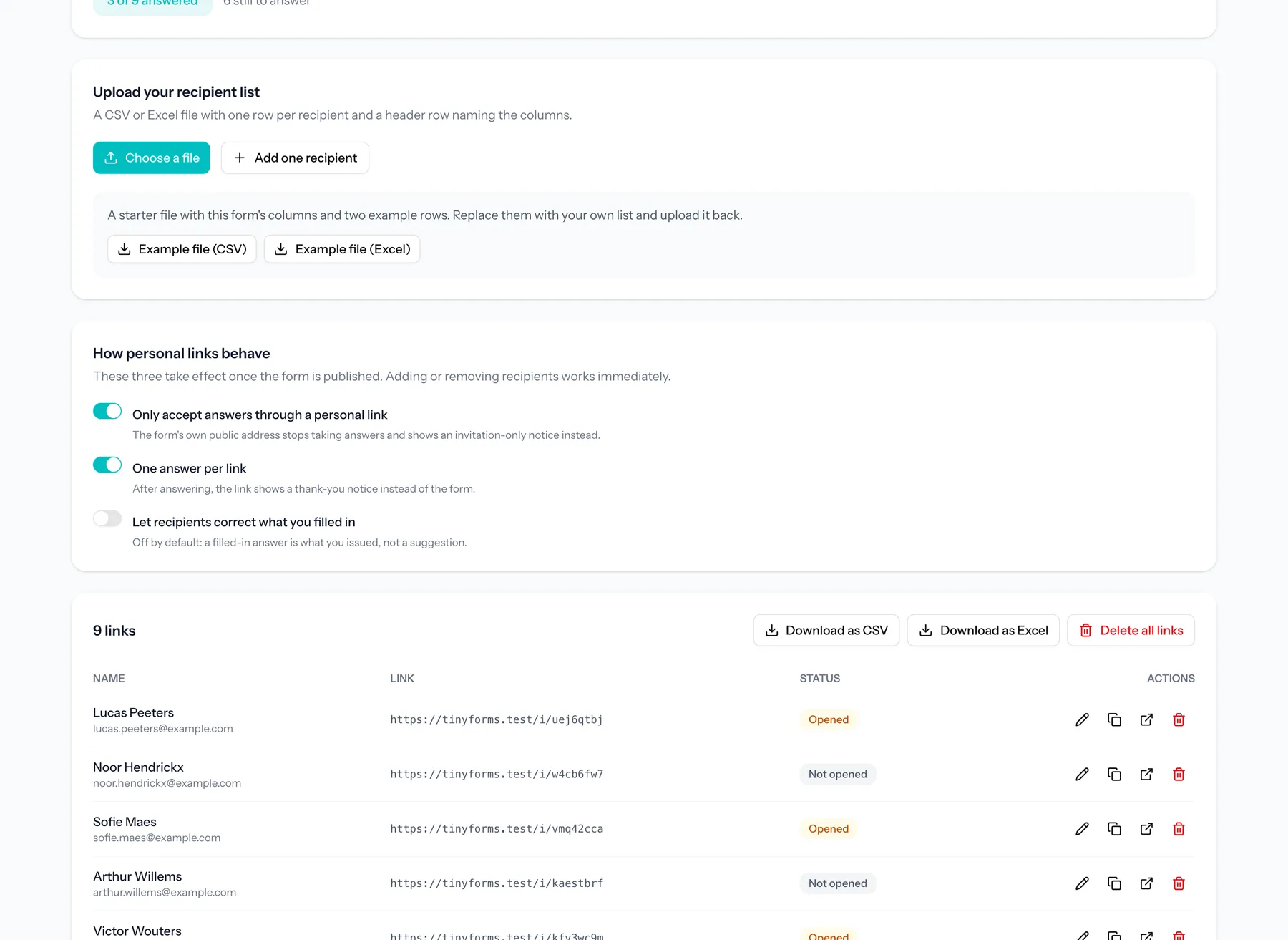
Uploading your recipient list
Open the Personal links tab in the form editor and upload a CSV or Excel file. The first row is read as the header naming the columns, and every row underneath becomes one recipient.
Start from the example
Download the example file from the tab. It already carries this form's columns and two example rows, so you can replace them with your own list. CSV or Excel, up to 2,000 rows per upload.
Check the columns
TinyForms shows every column with its first few values, so you can see what you are working with before anything is created.
Check the mapping
The first column is taken as the name, the second as the email, and every column after that is carried along hidden under its own name. Change any of them, and point a column at a field if you want it to fill in an answer or narrow the choices.
Generate
One personal link per row, each with its own address.
What a column can be used for
- Name of the recipient: shown in your list and at the top of their form. It is not stored as an answer.
- Email address: kept for your own reference. TinyForms does not send the invitations.
- Fill in an answer: the value lands in the field you point it at and, by default, cannot be changed by the recipient.
- Limit the choices: only the options named in that column stay selectable on a dropdown, radio group or checkbox field. Separate several with a semicolon.
- Carry along, hidden: never shown and never asked, but travels with the answer and comes back in your export.
Values are matched on what respondents see
A column holding "19 November" matches the option labelled "19 November" as well as its stored value, so you can keep your spreadsheet in plain language.
Adding or correcting one recipient
Every campaign gains a recipient late, and every uploaded file has one row that was wrong. Add one recipient opens the same panel as the edit pencil, and both reach everything a column of your file can: the name, the email, the answers filled in, the choices that stay selectable, and the hidden context. Nothing has to be re-uploaded to fix a spelling or move one person to another date.
- A recipient added by hand starts with the hidden keys the rest of your list already uses, so you fill them in instead of retyping them.
- Editing never changes the address, so an invitation already printed or sent keeps working.
- The panel shows the whole recipient: an answer you clear is cleared, and a choice you untick is no longer limited.
How links behave
Three settings decide what a personal link means for this form. They are part of the published form, so publish once after changing them. Adding and removing recipients always takes effect immediately.
- Only accept answers through a personal link: the form's own public address stops taking answers and shows an invitation-only notice.
- One answer per link: after answering, the link shows a thank-you notice instead of the form. On by default.
- Let recipients correct what you filled in: off by default, so a filled-in answer is what you issued rather than a suggestion. It concerns answers only; hidden context is never shown either way.
A link is not a login
Whoever holds the address can answer as that recipient. That is the right trade for an RSVP or a renewal, and the wrong one for anything you would otherwise protect with a password.
Following up and exporting
Each link shows whether it has been opened and whether it has been answered, with a running count of how many recipients have replied. Download the list as CSV or Excel to get every row back with its generated address, code and status, plus the hidden columns you carried along. That export is the file your print shop or your own records work from.
Deleting recipient data
Personal links hold names and addresses before any answer exists, so deleting a link is how that data is erased. Delete one link, or the whole list at once. Answers already given keep the hidden reference that travelled with them and simply lose the pointer back.
Not covered by automatic purging
Unlike submissions, personal links are never deleted automatically. A printed address has to keep working for as long as the campaign runs, so clearing the list stays a deliberate act. Deleting the form deletes its links with it.